
Whose line is it anyway? Are taglines the changing face of brands?
 Taglines have been around for as long as brands have been, forever! Just like brands there are all kinds of taglines good ones, bad ones and also the what are they trying to says. They have and shall continue to form a part of Brand quizzes the world over. Brand taglines when and where use are an integral part of the brand identity and more often than not define the brand character.
There are brands that have stuck to the same line over years of their existence while some have had their taglines evolve. No wrongs or rights here. Just knowing what works for you best. Wait a minute! Did I just say what works for you? Damn right I did. That is precisely the trip most brand heads are on! Often we forget that as brands establish themselves the consumers become stakeholders, at the end of the day aren’t they the ones giving the equity?
Not so long ago, at one of the organisations I worked with, we were on the hunt for a new creative agency. So started my journey of identifying, short-listing and inviting agencies to pitch for our creative account. The invite was as is the custom accompanied by a brief. A week or more of clarification and discussions happened for the agencies to build their understanding and appreciate the brief. Without exception each of the six agencies that had confirmed participation asked us the same question.
“How amenable are you to changing the tag line?”
The tag line was to all of them and rightly so, the articulation of the brand intent/philosophy. Coming back, our response was of course “Open to discussion for the purpose of the pitch.” We had given the agencies the part that they loved best, a license for a creative tangent.
When they came back all of them, basis the homework they had done gave us their understanding of our understanding, the understanding of our customers and consumers and finally a prescription for where the brand should head. Different yet interesting perspectives all.
Point is, here were a set of people who were actually seeking to receive the messages that we were sending out into space and this was their interpretation of what we were trying to say. Imagine the number of interpretations that would exist in the real world where people are not seeking you out.
How many actually register these one, two or probably five words that we as brand creators and custodians plaster all over the place with our other identity marks? Assuming they are registering it, how unambiguous is our articulation?
Wordsmiths and brand creators within the organisation and the agencies perhaps spend hours and days crafting those magic words to perfection. These words that form the tag line are the brands way of telling the world at large either or all of these things, obviously just an indicative list
- What is our philosophy
- What we are
- What we do
- How we like to do things
- What do we want you to feel
- Where are we headed etc.
We also put frameworks in place with regard to the context, conditions and placement of the tagline on our communication and signage. One other thing that we should as brand custodians review is how often those very words are used as filter for our everyday actions and communication.
For example, what really is Nike’s interpretation of “Just do it” how do they live and execute it in their organisation. Most probably there is a thought through answer for this. However, who really is ensuring or checking to see whether that is the understanding of every employee or bulk of the consumers? Does it matter and if yes, what steps are taken to improve the understanding?
There are brands that use their tagline to communicate their journey or evolution. Thus changing it along the way. Moving it a step closer or a notch higher in terms of its relevance to its consumers. Some even move from the rational to the emotional space during the course of their journey.
For example Domino’s Pizza in India started off with their process and capability based “Nobody delivers better” to “Hungry Kya” trying to own food as a category on to “Khushiyon ki Home delivery” to its present tagline “Yeh hai rishton ka time”. Four taglines in a little under twenty years of history in India.
Another example would be that of Lenovo that went from the more cerebral “New World, New Thinking” to “For Those Who Do”.
There is also an increasing incidence of a local articulation of the global thought. Taglines that used to be sacrosanct and uniform across the globe some years ago now come in a local flavour almost like campaign lines. This perhaps is not just true for taglines alone, some brands are allow multiple versions of their logo to co-exist, transition is not really that high on the agenda.
Some brands like Nokia on the other hand have pretty much dropped their tagline “Connecting People” from its pride of place just below the name for regular use, bringing it out only on occasion.
The rules of the game, perhaps the game itself is changing. Brand identities of today exist in multiple spaces and forms. The role of the tagline just might be changing from registering impact to grabbing attention!
Bringing me to the starting premise what is the line for anyway? For you (the consumer) to understand me or for me (the brand) to tell you what I want to. Is there really any purpose the taglines serve or is it just a ball of wool thrown at the curious cats in the business schools to discuss, debate and write about.
Fellow marketers your opinions please.
Indian Pigheaded League: When Brands become Stubborn
 As I write this post, the IPL 7 auctions are underway. The PR machinery of the franchise is working overtime to get people enthused and excited. From conversations around which player in which franchise to new kids on the block the twitter universe is abuzz.
There is no denying the fact that IPL perhaps has been one of the most popular leagues anywhere in the world. Cricketers of all cricket playing nations with or without test status would give an arm and leg to feature in the league and earn themselves a contract. A lot has been written about how the younger lot of cricketers yearn a chance to play the IPL over donning the national cap!
Someone once said that any publicity is good publicity. Brand IPL seems to live, breathe and propagate this credo. Seldom has a brand been so synonymous with controversies. One might opine that controversy is a design element of the product that IPL is.
What is surprising is that even aspersions on the quality of the core product viz T20 cricket have not come in the way. From match fixing to betting, physical assaults to sexual assaults the IPL seasons have witnessed a range of controversies.

Slapgate 
The Brawl 
Molestation 
Corruption 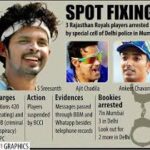
Spot Fixing 
The Inquiry Good or bad, right or wrong. Let’s face it IPL is a commercial enterprise. A vehicle for other brands to be seen and heard. The designed for Television IPL has seen a declining trend over the past 6 seasons as far its TV ratings are concerned, they are none the less significant. The season six had almost Rs.800Crs riding on it as advertising revenues. That seems to be brand IPL’s reason for chugging along as well. It is for all practical purposes the Super Bowl equivalent of India. Brands plan for their IPL related spends and campaigns much in advance. Those who are not associated or cannot afford the IPL keep their plans ready for reaching consumers outside of the IPL juggernaut during the 45 day spectacle.
A recent report put IPLs brand value in excess of $3Bn with a combined brand valuation of the franchises at over $400Mn. With the depleting central pool and the allied sponsorship/merchandising revenues, the question mark over the franchisees making money however continues. The brand valuations of the individual franchises seems to be the redeeming factor for the investors at the moment.
IPL 6 despite the fixing controversy still beamed into a whopping 129Mn households in India. Might perhaps is right. The might of brand IPL seems to be in its popularity or the numbers. Maybe Indians are so used to the typical masala pot-boiler entertainment format that they have made an allowance for all the negatives in the IPL format.
The question that is begging to be asked is whether brands can truly benefit from an association with a “property” that is so mired in the long run? Is there such a thing as a negative rub-off? After all, media planners and agencies do sell the positive rub-off from an association with integrated properties. Does the end really justify the means?
I guess the Indian consumer is an innocent forgiving lot. More often than not, they judge you for who you are and not who you are seen or associated with. That’s our culture perhaps, our mythology treats a Karna and Vibhishana with respect despite their association with evil.
We are accepting of the multiple shades of grey.
Meanwhile, IPL the brand and the brands that ride on it march on stubbornly into Season 7.
ALIENS: The Destruction of Brand Delhi (and India)
 The past decade has witnessed a surge in the social networking space from a digital perspective. The by-product of this from a marketing perspective has been the renewed interest of brands in building communities. There have been brands that have been at it even before the dawn of the digital era. All of us as marketers have read and discussed about how brands stand on communities and not campaigns.
This post though, attempts to look at the flip side. How communities through their actions build (or in some cases destroy) brands. In a hyper-connected world every and any incident has the potential to trigger a mass reaction. Malcom Gladwell, in his book The Tipping Point has given several examples of how seemingly disparate events can be cinders that light up and cause a wildfire!
Delhi, the capital city of India has been at the centre media attention for a while now. As a city and as a brand Delhi has always been a city that evokes reactions that are on the extremes. At this very moment however, the Net Promoter Score (NPS) of Delhi would perhaps be very low.
Just under 7% of the GDP of India comes from tourism. The 12th Five Year Plan (FY2012-17) puts its bets on Tourism as a sector that can deliver above the national average growth of between 10-12% whilst creating 5.5 to 6.7Mn jobs from the impetus that it can give to allied sectors. Traditionally, the so called focus on tourism has meant multi-million rupee campaigns by State Tourism departments and crass commercialization has ensued around the “destinations”. The bare necessities such as infrastructure and hugely warranted “social conditioning” have at best been given lip-service.
[youtube=http://www.youtube.com/watch?v=bVP23HJJKGs]
Delhi has been touted as the Soul & Spirit and the Gateway to India. A city where the ancient and the modern blend seamlessly.
[youtube=http://www.youtube.com/watch?v=frcJTfOHcpU&list=PLiml7Nodn9kqM5_rG_tXpv6onvGOdEUzi]
In the spotlight as far as this post is concerned are 3 recent incidents that I believe are pushing closer to the point of imminent disaster. These are incidents that depict how Delhi (Aam Aadmi and the Aam Aadmi Party) treats Tourists, Foreign Nationals and does not spare its own nationals from the other parts of the country! All of these certainly have had an impact on Brand Delhi and on Brand India. Let alone “Atithi Devo Bhav” we treat our guest worse than how Aliens get treated in cinema. Ranging from ridicule to suspicion, objectification to torture.

The Vigilante Incident 
The Tourist 
The Different Looking Guy If we have to serve our own interests as a community this is as good a wake-up call as any before we hit the tipping point. The onus therefore, is on us as a community and a society to build Brand Delhi or Brand India.
Living on the edge
We would all agree that it’s a tough job getting our message across to our target consumers. Add to that a puritan (engineers) definition of communication which is considered complete only when it is interpreted by recipient in the same manner as intended by the transmitter (Prof B at my engineering college must be heaving a sign of relief) and we are talking a steep slope that needs to be climbed.
As mentioned in one of my previous posts, the purpose of this blog is not to propound new theories, it is to present a perspective. So pardon references to Marketing 101.
Moving on, consumers today exposed perhaps over-exposed to messages of all sort. Thus to laden the expectation of decoding/deciphering our communication is expecting a bit too much. Moreover, pumping in marketing dollars hoping that he would is bizarre!
Most communication, even advertising operates on simple parameters we learnt in high school physics. Amplitude, wave-length and frequency. In advertising terms how loud, how long and how often. Well yes we pay the agencies and other experts to do that bit.
The most important bit and hopefully as marketers we hold it close like dear life is the what.
Establishing any communication is, has been and perhaps always will remain an uphill journey. One must realize though that the other side of the cliff is a steep fall. The best time spent therefore, would be at the top living on the edge.

What we communicate goes through the organic phases milestones on the climb that I have chosen to call Ignorance, Recall, Attention and finally the top Recommendation.
The other side however, is the steep fall which starts with the flip side of recommendation i.e. Frustration and very soon thereafter Annoyance.
It is important to note here that what are being discussed are the stages of the communication not the brand per se.
Bringing back the concepts of how loud, how long and how often a marketer would need to be careful with the communication once it has been established. Push it to loud, long or often chances are you will find yourself free-falling straight to annoyance.
To make my point how a communication is living dangerously on the edge and to bring alive the discussion I am leaving you with recent communication from a popular brand.
- The start
http://www.cadburyindia.com/in/en/brands/pages/videoplayer.aspx?vid=1609
- The build
http://www.youtube.com/watch?v=65ilZ8esAUs
- The extension
http://www.youtube.com/watch?v=Ag68swbxQvc
- The (un-necessary) stretch
http://www.youtube.com/watch?v=_WR844HP-yU


