
A Bridge Across India(s)
Marketing beyond the Demographic and Psychographic Divide
Context:
I recently read three articles in one of the newspapers. One that spoke about the income disparity that exists in India and if I may add, one that is widening. Combined with another article they tried to make sense of the income classes in India. A third article a few days later, gave data pertaining to education and economic affluence. Leaving the socialist aspects aside, the averages as usual by themselves are misleading and deceptive.
Exhibit A:
According to a statistic (source or basis not explicitly mentioned by the report) an income of Rs2.9Lakhs per annum puts one into the Top 10% earners and to enter the Top 1% an income of Rs.20.7Lakhs per annum shall suffice. However, to get into the Top 0.1% you need an annual income of Rs.2.25Crores. The comparable numbers in terms of accumulated wealth or net assets for these brackets are Rs.21Lakhs and Rs.82Lakhs for the Top 10% and Top 1% respectively.
Exhibit B:
The associated article in the same newspaper quoted data from 2 reports namely the Indus Valley Report 2025 and the Knight Frank Wealth Report 2025. The Indus Valley Report proposes the concept of 3 Indias based on income categories
- India 1 – Representing the wealthiest 10% of the population who have a per capita income of USD15000 (Rs12.8Lakhs) comprising of approximately 30MN households
- India 2 – 23% of population with per capita income of USD3000 (Rs.2.5Lakhs); ~70MN households
- India 3 – 67% of population with per capita income of USD1000 (Rs.85Thousand); ~200MN households
Exhibit C:
The third article looked at the social caste construct and how it impacted education levels. Education it opined and I agree is perhaps the biggest factor in inter-generational upward mobility. The article also referred to data gathered by the NSSO.
Premise:
Looking at these numbers set the marketer in me thinking about what lies beyond these income/wealth numbers and how we as a tribe use the demographic data for creating/defining our target audiences. The thought then led to a further reading and assimilation of data from a wider range of articles and reports.
What also found its way into my thinking were my recent experiences with studying Consumer Archetypes and my interactions with a vast set of consumers trying to understand their aspirations and motivations.
While by no means exhaustive or even pretending to be scholarly my notes as I made them threw up a pattern that potentially can serve as a de facto framework for marketing to Indian consumers based on 3 broad dimensions:
- Geographic
- Economic and
- Psychographic
A combination of these dimensions help us understand the 4As namely Availability, Affordability, Accessibility and Acceptability of Products and Services that we marketers aim to influence and promote.
Marketing is essential for raising awareness, building trust, and encouraging the use of services and products.
From the point of view of the Geographic Divide i.e. Urban and Rural, inclusive marketing involves more than just targeting rural audiences—it requires a thoughtful understanding of their distinct challenges and cultural backgrounds to create meaningful connections and promote the adoption.

Nielsen reports provide important insights into overall consumer trends, spending patterns, and the key role affordability plays in shaping consumer behavior across different groups. With much of India’s economic activity and spending power concentrated in urban areas, a targeted approach is essential to effectively understand and engage rural markets through customized marketing strategies.
- Rural consumers are generally more price-sensitive and favor local brands that meet their needs and budget.
- Urban consumers are more brand-conscious and are influenced by national/international brands and media trends.
- Rural families are often larger, with centralized decision-making by one person.
- Urban families are usually smaller and nuclear, with shared decision-making between male and female members.
On the Economic dimension, the narrowing of the consumption – expenditure gap between urban and rural areas, coupled with the increasing inclination towards non-food items in rural spending, signifies an expanding market with evolving needs and preferences. Marketers who recognize this burgeoning potential and tailor their offerings to meet these specific demands are poised for success.
Fueled by rising income levels and various government support initiatives, the purchasing power of rural consumers is on an upward trajectory.
Growing access whether in terms of transport infrastructure paving access to higher order necessities such as health, education or to information and awareness courtesy the digital access that the penetration of mobile phones and internet have meant higher aspirations.
Believe it or not the axis, however low it might have been has considerably shifted up and right over the last 2 decades. Therefore, understanding the Psychographic aspect of the change is an imperative. Unfortunately, as old school as I may sound, data alone cannot get marketers across the line.
There is no substitute to first hand exposure to the consumer. A marketer worth her salt cannot, dare I say should not compromise on living a day in the life of the consumer(s) they aspire to market to. Multiple times over, if need be.
Bridging the demographic and the psychographic divide in India necessitates a strategic and sustained commitment to understanding and effectively serving the unique needs of different archetypal consumer profiles that emerge based on the dimensions and factors outlined.
Archetypes
Debatable as they may (and intentionally so) the broad archetypes that emerged according to my notes are as below:

The Rulers
The prime movers and shakers if not already who-is-who these are folks who are heading there or at the very least striving to. They are setting trends and shaping narratives – social, political and economic as they go along. The Rulers are the HAVES.

The Controllers
They are the country cousins of the archetype just above. They have POWER and do not hesitate to wield it. They are always in-step or at worst one behind with what is current and trending. Social superiority is essential. The Controllers are the MUST HAVES.

The Aspirers
Their trajectory is pointing upwards and their ambitions are keeping it there. They have SKILL and KNOWLEDGE to get where they want to. They are the difference between a fad and trend! They are the WANTS.

The Dreamers
They are doing well for themselves though things could always be better. The dreamers are happy with the fact that it is possible for them to be better. However, ambition takes back seat for sentimental reasons or contentment or pragmatism. They are the COULD BES’.

The Warriors
They are inching towards a better life for themselves. Every day is a battle they fight and WIN. Bruised and battered they may be but they wear their battle scars with pride. Making ends meet is not the goal it is something they have to do to get to it. The Warriors are a tribe that is armed with a can do spirit but they are the MUST DOS’.

The Survivors
They have limitations, severe ones. The absence of privilege of any sort is what defines them. Yes, they depend on others but that is just the cards they have been dealt. There is a desire to change their future and rid themselves of the baggage of the past (socio-economic). They are the NEEDS.
3×2 India Framework
This proposal based on a top-level analysis of consumer psychographics and consumption patterns unveils distinct differences between urban and rural populations across the economic divide. The image that follows tries to give context to the archetypes on 2 axes based on Geographic and Financial. This placement of consumer types in context underlines the need for tailored marketing strategies across the archetypes.

Key strategies for success include prioritizing localized product offerings and pricing, building robust distribution networks that penetrate remote areas, utilizing local languages and culturally relevant messaging, and fostering trust through transparency and community engagement.
Conclusion
The increasing reach of digital platforms presents significant opportunities, but addressing the challenges of connectivity and digital literacy requires a hybrid approach that integrates digital outreach with strong community-based initiatives.
There are some useful and celebrated case studies in the form of Project Shakti and e-Choupal that demonstrate that a deep understanding of the local context and a willingness to adapt strategies are fundamental to achieving meaningful impact in rural India. However, these need to be perhaps revisited through the lens of economic disparities too.
Ultimately, bridging the divide requires a long-term commitment from businesses in general and more specifically marketers along with other stakeholders to create a more inclusive and holistic marketing construct that speaks to all consumer types.
Ready?!
Brand Supernovas (2025)

How many times have brands or companies simply be-dazzled you with their products, communication, pace of innovation, service delivery etc. and then suddenly dropped off the planet?
Not often, but I bet most of us would come up with an example or two.
Got thinking on similar lines and tried racking my brains to come up with a list my own. Funny thing with lists though is that you want the number of items on it to reach a nice round figure. What I figured was; whatever number that you can get to without stretching the core thought is probably the right number to have on the list. I am sure you nodded your head to that one.
Before I started writing this post I looked up the term “Supernova” in the dictionary
su·per·no·va (so͞o′pər-nō′və)
A rare celestial phenomenon involving the explosion of a star and resulting in an extremely bright, short-lived object that emits vast amounts of energy. Depending on the type of supernova, the explosion may completely destroy the star, or the stellar core may survive to become a neutron star.
I have for the purpose of this post highlighted what I believe are the operative parts.
Before I go on to cite examples let me establish the basic premise which is, a successful brand is the coming together of a great product or service and communication that resonates with the consumer leading to a distinctive identity, a marked preference and a position of leadership. Now, that’s an elevator pitch definition of brand success that covers most if not all bases.
Now brands fade for a variety of reasons and hundreds go into oblivion every day. Mostly because they didn’t deliver on the promise that they made. Reasons could be they stopped being relevant or they got complacent or they were poorly managed etc. The very opposite at one time or the other must have got them to the top. It is however important to make a distinction between brand supernovas and brand fads.
Brand supernovas are the ones that seemed to have got it right. Well at least for a while.
Now for the examples. Here are brands that shot up high and lit up the horizon while they were at it. Almost all these brands had a great product/service idea that went down extremely well with consumers, customers and investors. Not all of them spent big bucks on advertising and communication but they sure captured more than a fair share of imagination – to the extent that nobody imagined them going bust or fading away into oblivion.
- Fitbit – a pioneer in the wearables/fitness tracking space that rose to a dominant 37% market share and over USD10BN in market cap after going public in 2015. The heady success though didn’t last as Fitbit failed to sustain it’s first mover advantage. Wearables as a category saw a significant shift with brands like Apple upping their game. Fitbit’s revenue started to decline after 2016, and their market share also decreased considerably. Despite an initial high valuation, their brand value also saw a downward trend, eventually leading to their acquisition by Google in 2021. Google too sunset the brand soon after.
- PepperTap – Launched in 2014, India’s early attempt at quick commerce premised on a hyper-local /aggregation/commission based delivery model chalked up millions of subscribers and users as also millions of dollars in initial funding. To its credit, PepperTap had a fantastically simple and seamless user experience and some good algorithms to get the logistics right. However, a combination (arguably) of a misplaced sense of urgency wrt to expansion and heavy discounting saw the brand/company falter and lose its way. The fame and the glory were short-lived. By April 2016 PepperTap management had to announce a shut-down of it’s consumer facing operations. Subsequent attempts at revival in a B2B avatar too failed.
- Koo – Touted as India’s multi-lingual answer to X (erstwhile Twitter) this was a brand that lived only long enough to disappoint. The reason I mention Koo is that it reached a whopping 60MN users at it’s peak – no small achievement. Birthed at a time when India’s Nationalist sentiment was at it’s peak and perhaps helped along by an over-enthusiastic media response Koo did have something novel to offer to its users initially.
There of course are several other brands in the past decade that began their journey and met with great success. Some continue to grow, expand and flourish whilst some have run into some rough weather.
Some of the brands that spring to mind are Snapdeal, Groupon, Yumist which burnt bright for a brief while. Yet others such as Byju’s and WeWork on which the jury is still out.
10 Tell-tale Traits of Terrible Leadership
The fact that you have gone beyond the title and started reading this post is proof that tapping into emotions is easy and tapping into negative emotions easier 😊
I have been thumbing through multiple books and articles on leadership and management as part of research that I am doing. That combined with experiences in my own professional life (including yours truly as a leader) have led me to distill my considered opinion into this blog post.
What I am about to present to you are traits that one must be on the lookout for if you are being led and even more so if you are the leader. There are ten tell-traits that one must be wary of. Every leader I know of or have read about has had at least one of these flaws. All leaders, depending on situation and context, are prone to displaying these traits. The challenge and a big one is when these traits are on display consistently.
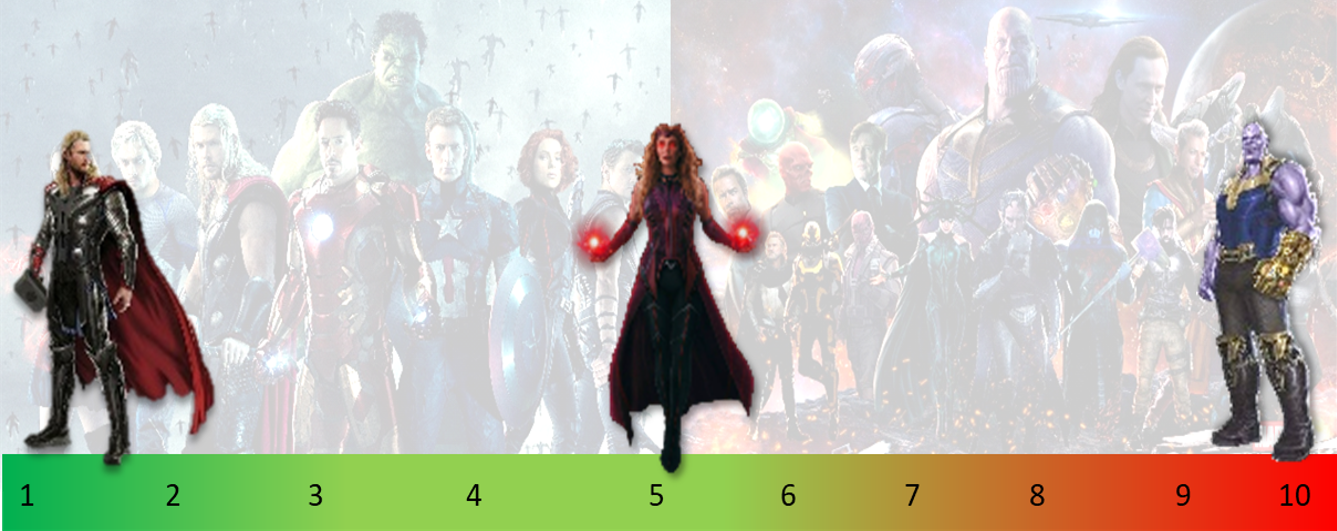
The score on a scale of 1-10 would have a fictional superhero like character on one end (say Thor) and a villain (Thanos) on the other with Wanda as the inflection point between the forces of good and bad. Fictional for the simple reason, nobody is that perfect or even that flawed! To those unfamiliar with the Marvel Comic Universe – just replace the names with superheroes or villains with whom you are familiar.
So here are the Tell-Tale Traits in no specific order. How many can you associate with yourself or with a leader you know?
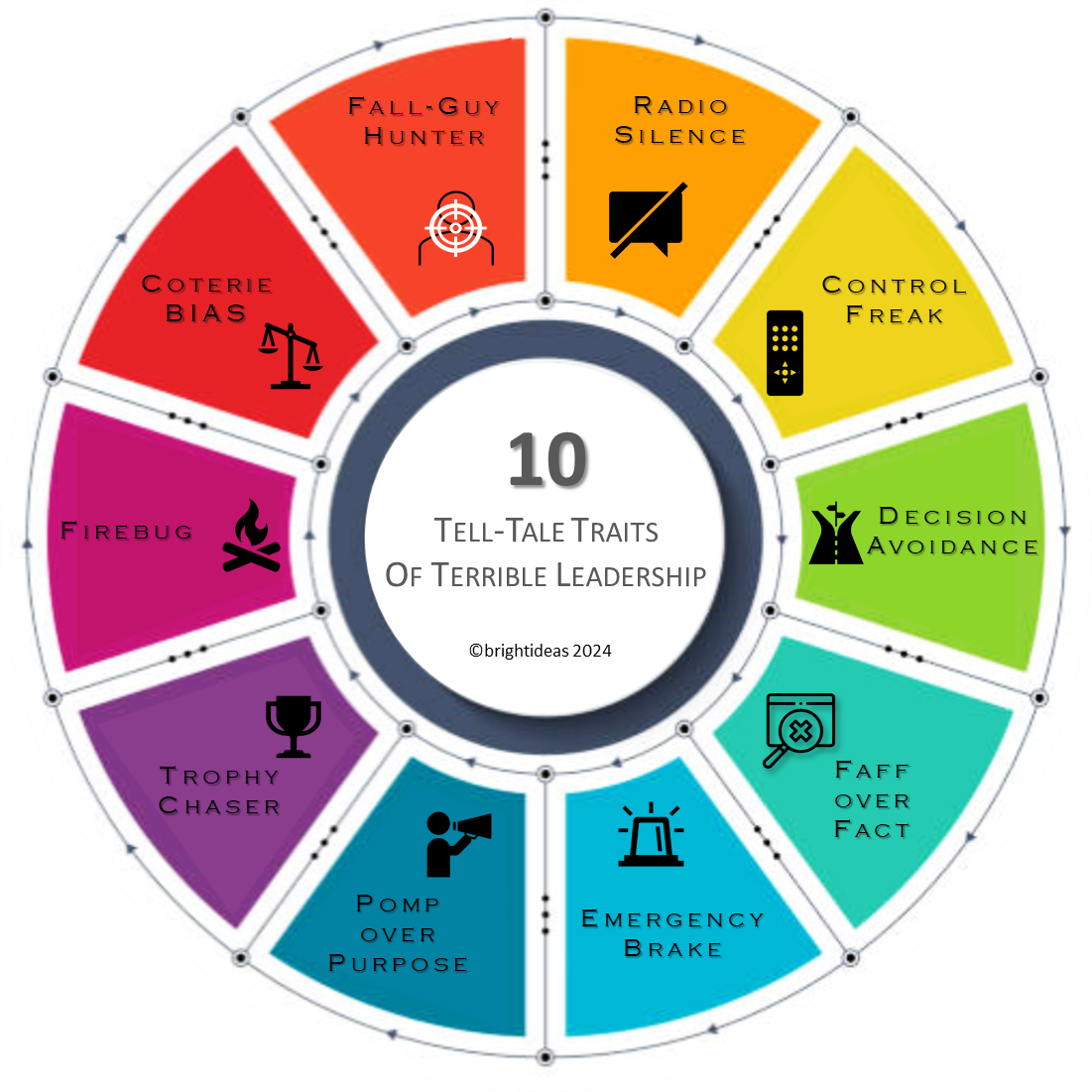
- Radio Silence: A leader who does not interact often with the team or interacts only when there is a task to be assigned or only on occasion or with an appointment is bound to end up as an unpopular one. Again, this is not to say that one must be an extrovert to be a good leader. It is accessibility that is crucial for leaders. Styles of interaction may differ but one thing that all good leaders do is make an effort to be seen in the trenches.
- Control Freak: While it is important to monitor progress, we all have seen leaders who get under your skin with their supervision. A key requirement for a leader is the ability to delegate tasks. There is skill associated with the ability to identify appropriate resources for the task and setting clear success metrics. A skill the Control Freak lacks.
- Decision Avoidance: This is thin ice. A leader is expected to be decisive. Procrastination, though avoidable, is still acceptable. After all, situations need to be analyzed and consequences weighed but a leader who constantly avoids taking decisions is trouble incarnate.
- Faff over Fact: A leader who often focusses on optics and is happy to gloss over facts is a potential integrity and ethics disaster waiting to happen. Convenient interpretation and cuts of data are a trap. A leader who accepts or looks the other way when a subordinate does it is worse. There will come a time when one too many facts have been overlooked or misrepresented. You do not want to be around when that happens.
- Emergency Brake: This is a trait often seen in conjunction with trait three above. A leader who is not fully or deeply engaged is often the one who resorts to the application of emergency brakes. In general, there is a lack of clarity or direction, and conflicting views abound. All work gets stopped, often with little or no explanation. A display of trait three ensues.
- Pomp over Purpose: Many new leaders are guilty of this. Some unfortunately continue with it. This is when leaders commission projects and campaigns, hold workshops and events needlessly under the garb of collaboration or building wider, deeper understanding. The return on time and money invested quite frankly is not a consideration nor are “understanding” or “collaboration” well-defined objectives. The idea is not to say no to such exercises, it is doing them with clear outcomes.
- Trophy Chaser: Again, there is nothing wrong with ambition or going for the win. If that were the case, there would be no examples from sport or war, especially, when it came to leadership. Winning is important, participation is important. But doing anything for the sake of just that is meaningless. You do not stop during a marathon to win a game of darts!
- Firebugs: Some people are busy like a hive. They can multi-task. The challenge is being fickle, not seeing through what has been set into motion to its logical conclusion. Such leaders are firebugs. They have the tendency to light multiple fires, the latest one invariably is priority, and they gather people around that one with scant regard for the status of fires lit previously.
- Coterie Bias: It is human to crave attention. We are all vain. Leaders too. Unfortunately, popularity as a leader is something only an exceptional few achieve. Some understand and learn to live with the fact. There are leaders though who create their personal bubble – surround themselves with people who laud them, right or wrong. Over time their reality alters based on facts/fiction that is fed to them. Often this leads to blatant, unapologetic biased opinions. Sycophancy is not just a terrible trait it is a dangerous one!
- Fall Guy Hunter: This is a trait that should set alarm bells ringing. A leader is accountable. In the real-world things do go wrong, all of us have at some point in our lives taken wrong decisions, made an inadvertent mistake. Yes, errors need correcting, performance needs improving, and the buck must stop somewhere. The leader has the right to reward or reprimand. That said, the onus is also on them to course correct and deliver. Error detection does not absolve the leader of their duties. Covering up is different from covering for. Mistakes are a test of character all round. A leader who throws his team under the bus is not worthy of his position.
The traits listed above are by no means exhaustive. They are nonetheless, traits that are highly visible/tangible.
A good starting point for all of us whether leaders or leadership aspirants or plain simple contributing units of a professional (even social) structure.
#Selfie Obsession: Are Brands Clicking it Right?
 If you are a marketer who has clicked to read about this, chances are, you are as much as at a loss of understanding as I am with this selfie business. Or, if I were to play with words, the disconnect between selfie and business.
Yes, “buzz” and “talkability” are mandates for any brand that exists in the sociosphere. But in my book they can be considered lead indicators of a brands virulence. The real measures have and should according to yours truly always remain in the business realm.
Selfies seem to be the newest big thing on the internet these days or to put it in real terms calling it one is. The rapid proliferation of social networking if nothing else, has given tremendous fillip to the narcissistic instincts of the digital natives. If one were to observe carefully most us have started leading these digital alter-lives and as much as we hate to admit it are pre-occupied with them. Point is, people have been taking self-pics ever since they put cameras on mobile phones and for as long as social networking sites have been around. The proof lies in the fact that with over 4billion taking pictures with their mobile phones, Nokia has perhaps sold more digital cameras by a factor of A VERY BIG NUMBER than the nearest camera maker and that Facebook carries more pictures than the Picasa’s of the world.
So what started as an alleged faux pas with the Obama selfie has snowballed into an acceptable behaviour over a short span of a few months with the Ellen DeGeneres selfie at the Oscars. So much so that we now have marketing campaigns built on selfies. A departure from an era not so long ago where this would have been the digital activation angle for a larger thought.

Ellen @ Oscars Selfie 
Obama @ Mandela Funeral Selfie The concept of #Selfie is inherently linked to cosmetic brands and as mentioned earlier several brands decided to ride the selfie trend and as usual some have it together some sadly don’t. As marketers we tend to get swayed and tempted by latest trends. Under the guise of innovation we flirt with these trends with or without a defined purpose. The flavour the past couple of seasons were flash mobs countless brands spent millions of dollars behind these trends. Someone somewhere must pause to think whether having a new angle on the whole thing is sufficient to press the go button.
Here’s a compendium of campaigns that I came across. Do take a look and judge for yourselves which ones actually helped the brand grow and which ones were “Oh! We did that too”.
http://www.youtube.com/watch?v=o6NVxRunn_E
Till such time that we find a new craze the #Selfie Obsession continues.


